
By the numbers
- Started
- 15 March 1959, Mumbai
- Founders
- Seven women
- Starting money
- ₹80 (borrowed, per WIPO)
- First batch
- 4 packets of papad
- Members today
- Over 45,000 (Lijjat website)
- Branches today
- 83 (Lijjat website)
- Please note
- Figures come from WIPO (2013), Lijjat's own website (undated) and a government publication, and they differ between sources. We name the source and year for each, and note what we could not confirm.
Key takeaways
- Seven women began on 15 March 1959 on a building terrace in Girgaum, Mumbai; WIPO reports they borrowed ₹80 and made four packets of papad
- Lijjat is run as a women's cooperative: members, called sisters, are co-owners with an equal say, and its website reports over 45,000 members
- The lessons: start with a skill you already have, begin tiny, share ownership, treat quality as the brand and copy your own proven model
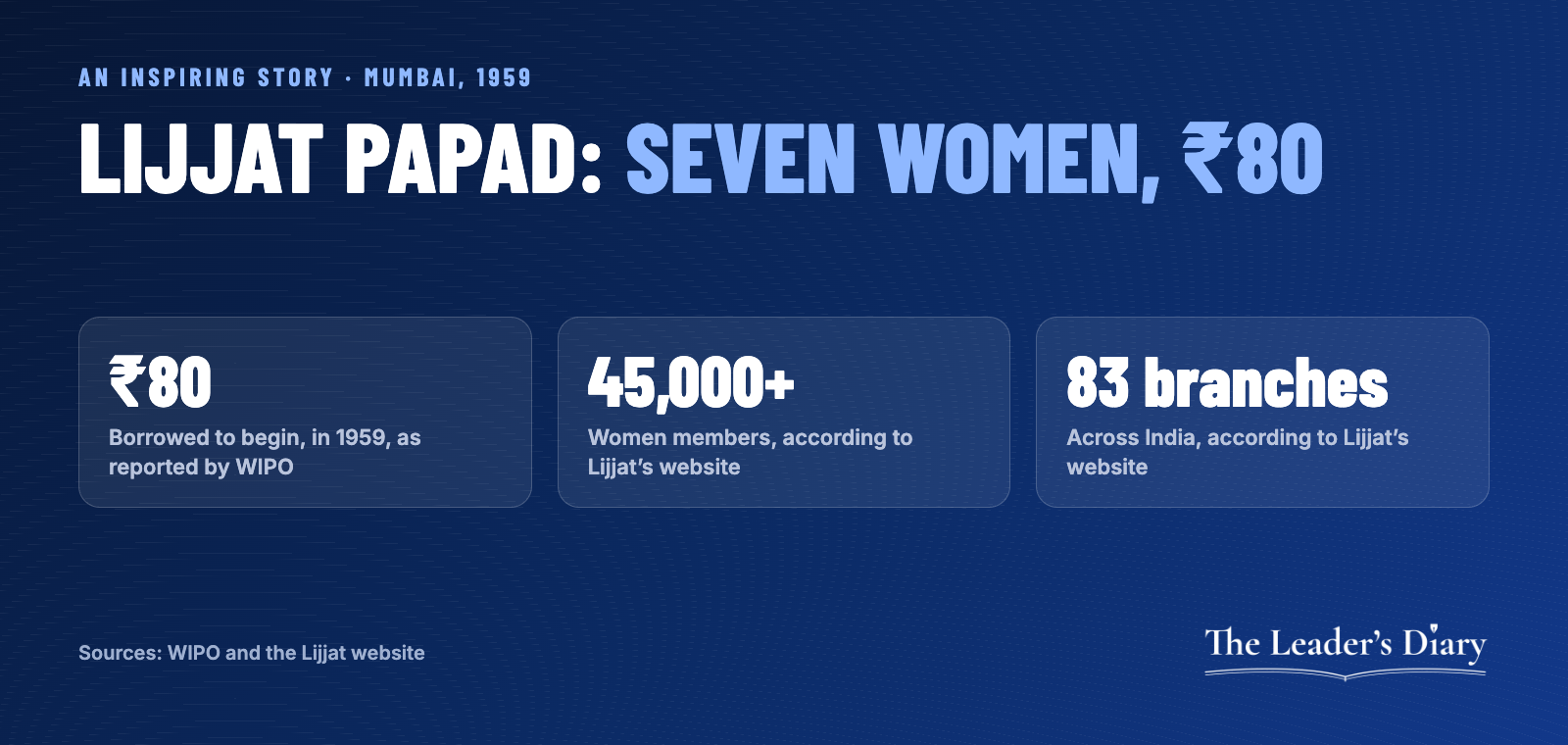
On 15 March 1959, seven women in an old residential building in Girgaum, Mumbai, began making papad on the building's terrace. According to the World Intellectual Property Organization (WIPO), they borrowed ₹80 to buy ingredients, and their first batch was four packets. Today Lijjat's own website says more than 45,000 women are members of the organisation, which runs 83 branches and 27 divisions across India.
The story of Shri Mahila Griha Udyog Lijjat Papad is one of India's best-known examples of how a small, repeatable skill, shared ownership and steady quality can grow into a national brand. Below is what the official and published sources say, which details differ between them, and what the story teaches anyone starting with very little money.
How it began: a terrace, seven women and ₹80
Lijjat's website says the story began on 15 March 1959 in Girgaum, a densely populated area of south Mumbai, in an old residential building. That morning, it says, most women in the building were busy with their usual household work, and seven of them gathered on the terrace.
WIPO's account adds the money. The women borrowed ₹80, less than one US dollar at the time, to buy the ingredients, and they made four packets of papad. They had a skill already, and no capital to speak of. As WIPO quotes the founders, they "realized our papad-making expertise could be used to earn small amounts of money". Within three months, WIPO reports, the group had grown to as many as 25 members.
Who were the seven women?
Lijjat's website does not name them. Wikipedia, summarising published accounts, lists the seven founders as Jaswantiben Jamnadas Popat, Parvatiben Ramdas Thodani, Ujamben Narandas Kundalia, Banuben N. Tanna, Laguben Amritlal Gokani, Jayaben V. Vithalani and Diwaliben Lukka. Treat that list as a secondary source.
One of them has an official record. Jaswantiben Jamnadas Popat appears in the Government of India's list of 2021 Padma Shri awardees, under Trade and Industry, Maharashtra. A government publication on 70 years of the Indian Constitution also holds up her story as an example of a women-led enterprise, noting that "Lijjat Papad" grew from ₹80 to ₹800 crore.
The loan itself is described differently in different places. Wikipedia, citing published accounts, says the women borrowed the ₹80 from Chhaganlal Karamsi Parekh, a social worker. Lijjat's website separately honours "Pujya Chhaganbapa" and the late Shri Purshottam Damodar Dattani, whom it calls "Pitamaha", for their guidance. The website does not state the amount, or who lent it, so we cannot confirm these details from the organisation itself.
From four packets to a movement
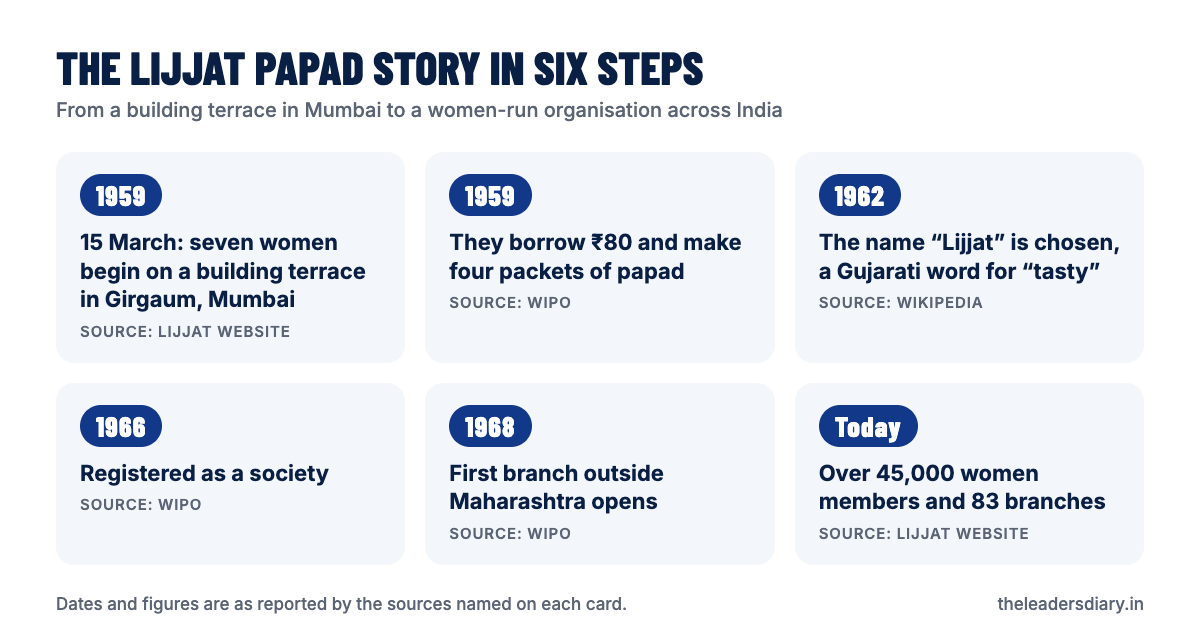
- 1962: According to Wikipedia, the group chose the name "Lijjat", a Gujarati word for "tasty", through a contest. The prize was ₹5, and the winning suggestion came from a member named Dhirajben Ruparel.
- The first year: Wikipedia reports first-year sales of ₹6,196, with production paused for four months in the rainy season, and sales of ₹1,82,000 by 1962–63. These come from published accounts, not from Lijjat itself.
- 1966: The organisation was registered as a society, according to WIPO. Wikipedia gives July 1966 under the Societies Registration Act, 1860.
- 1968: The first branch outside Maharashtra opened, per WIPO.
- 2013: WIPO reported more than 40,000 members and 62 branches across 17 states.
- Today: Lijjat's website says it has over 45,000 members, 83 branches and 27 divisions. It gives no date for those figures.
How Lijjat works
Lijjat describes itself as "a unique organisation of the women, by the women, for the women". Its members are called "sisters". WIPO reports that Lijjat is a cooperative in which each sister is a co-owner with an equal say. Wikipedia, citing published accounts, adds that decisions are taken by consensus and that the founders decided early not to accept donations, even if the organisation made losses.
WIPO describes a structure in which divisions run on their own but follow uniform guidelines, while buying is centralised. Sisters, it says, are over 18, work about six hours a day after training, and receive a monthly payment. In 2013 it put the average at ₹2,000–3,000. That figure is more than a decade old and should not be taken as current.
Quality and the brand are protected deliberately. Lijjat's website lists ISO 9001:2015 and ISO 22000:2018 certification and recognition by the Khadi and Village Industries Commission. WIPO reports that the organisation holds more than 40 Indian trade marks, including "Lijjat" (first registered in 1967), and has registered marks in the United States and the European Union.
How big is it? The numbers disagree
| Figure | Value | Source and year |
|---|---|---|
| Starting money | ₹80 (borrowed) | WIPO, 2013 |
| Members | Over 40,000 | WIPO, 2013 |
| Members | Over 45,000 | Lijjat website, undated |
| Branches | 62 in 17 states | WIPO, 2013 |
| Branches and divisions | 83 branches, 27 divisions | Lijjat website, undated |
| Turnover | About ₹650 crore | WIPO, 2013 |
| Growth | From ₹80 to ₹800 crore | Government publication, undated |
You will also find ₹1,600 crore quoted online for 2019. We have left it out of the table because the version we found carries a "citation needed" note, and Lijjat's own website gives no turnover figure. When numbers differ like this, trust the ones with a named source and a year.
What we could not confirm
- The names and individual roles of the seven founders, beyond Jaswantiben Popat's official award record.
- Who lent the ₹80, since Lijjat's website does not say.
- A current turnover figure from Lijjat.
- The date of the 45,000-member and 83-branch figures on Lijjat's website.
Six lessons from the Lijjat story (our analysis)
- Start with the skill you already have. The seven women did not need a new idea. They turned something they could already do well into income.
- Start tiny and prove it. Four packets and ₹80 is about as small as a beginning gets. It was enough to find out whether people would buy.
- Share ownership. Equal say and shared earnings give people a reason to protect the business and the brand.
- Treat quality as the brand. A customer buys the same taste every time. Lijjat now backs that with ISO certification, and it protects its name with trade marks.
- Copy your own model. Growth came from repeating a proven way of working in new places, with common guidelines and central buying, instead of reinventing it each time.
- Be clear about who you serve. "By the women, for the women" was a purpose people could understand and join.
What this means if you are starting with little money
- Pick something you can already make well and can make the same way every time.
- Test it with a few customers before you spend money. Our break-even calculator shows how many sales you need to cover your costs.
- If you make or pack food for sale, check the licence rules first. Our guide to the new FSSAI rules explains registration and licences.
- Write down your standards for quality and stick to them. Customers remember consistency.
Questions people ask
Who started Lijjat Papad?
Seven women in Girgaum, Mumbai, who started on 15 March 1959. Lijjat's website does not name them. Wikipedia lists seven names, and one of them, Jaswantiben Popat, is in the government's 2021 Padma Shri list.
How much money did they start with?
WIPO reports they borrowed ₹80 to buy ingredients. Lijjat's website does not state the amount.
What does "Lijjat" mean?
According to Wikipedia, it is a Gujarati word meaning "tasty". The name was chosen in 1962.
Is Lijjat a cooperative?
WIPO describes it as a cooperative in which members, called sisters, are co-owners with an equal say. It is registered as a society.
How many women work with Lijjat today?
Lijjat's website says over 45,000 women, across 83 branches and 27 divisions. It does not give a date for those figures.
Know a story like this?
If you know a business that started small and grew through skill and teamwork, or if you run one, tell us the story. We would like to feature real stories that inspire others.
This article is compiled from public sources, which are listed below, and is not affiliated with or endorsed by Lijjat. Dates and figures are as reported by those sources and may have changed. It is not financial advice.
Sources
- Lijjat Papad (Shri Mahila Griha Udyog), official website and About Us page
- WIPO, Pappadums and the Path to Empowerment (page last updated July 2013)
- Ministry of Home Affairs, Padma Awards 2021 list (Padma Shri, no. 81, Jaswantiben Jamnadas Popat)
- 70 Years of Indian Constitution, page 45 (Government of India publication on PIB's website)
- Wikipedia, Shri Mahila Griha Udyog Lijjat Papad (secondary summary of published accounts, used for founders' names, the name's origin and early figures)
- Cover photo: Windell H. Oskay, "Stack of papadums" (Wikimedia Commons)
- Photo licence: Creative Commons Attribution 2.5 (CC BY 2.5)
- Packet photo: Senorhorst Jahnsen, "Lijjat Papad package 03" (Wikimedia Commons, CC BY 2.0)
- Photo licence: Creative Commons Attribution 2.0 (CC BY 2.0)
- The six lessons are our own analysis. This article is not affiliated with Lijjat.
Figures are estimates and vary by city, size and season. Last reviewed: 14 Oct 2026.