By the numbers
- Registration
- Turnover up to ₹1.5 crore
- State licence
- ₹1.5 crore to ₹50 crore
- Central licence
- Above ₹50 crore
- Renewal
- Not needed (new licences)
- Earlier limit for petty food businesses
- ₹12 lakh
- Effective from
- 1 April 2026
- Please note
- Based on FSSAI's orders dated 13 and 27 March 2026. The orders do not state fees. Check the FoSCoS portal and your state food safety office before you apply.
Key takeaways
- From 1 April 2026: registration up to ₹1.5 crore turnover, State licence above ₹1.5 crore up to ₹50 crore, Central licence above ₹50 crore
- Licences and registrations issued on or after 1 April 2026 stay valid unless suspended, cancelled or surrendered
- Existing holders move to the right category through FoSCoS with no fee and keep their licence number
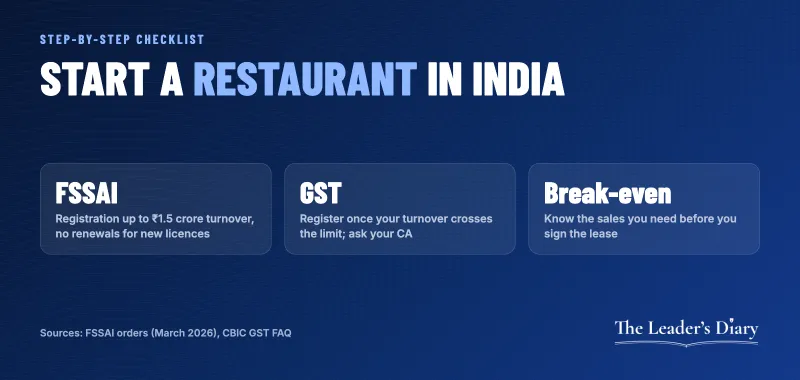
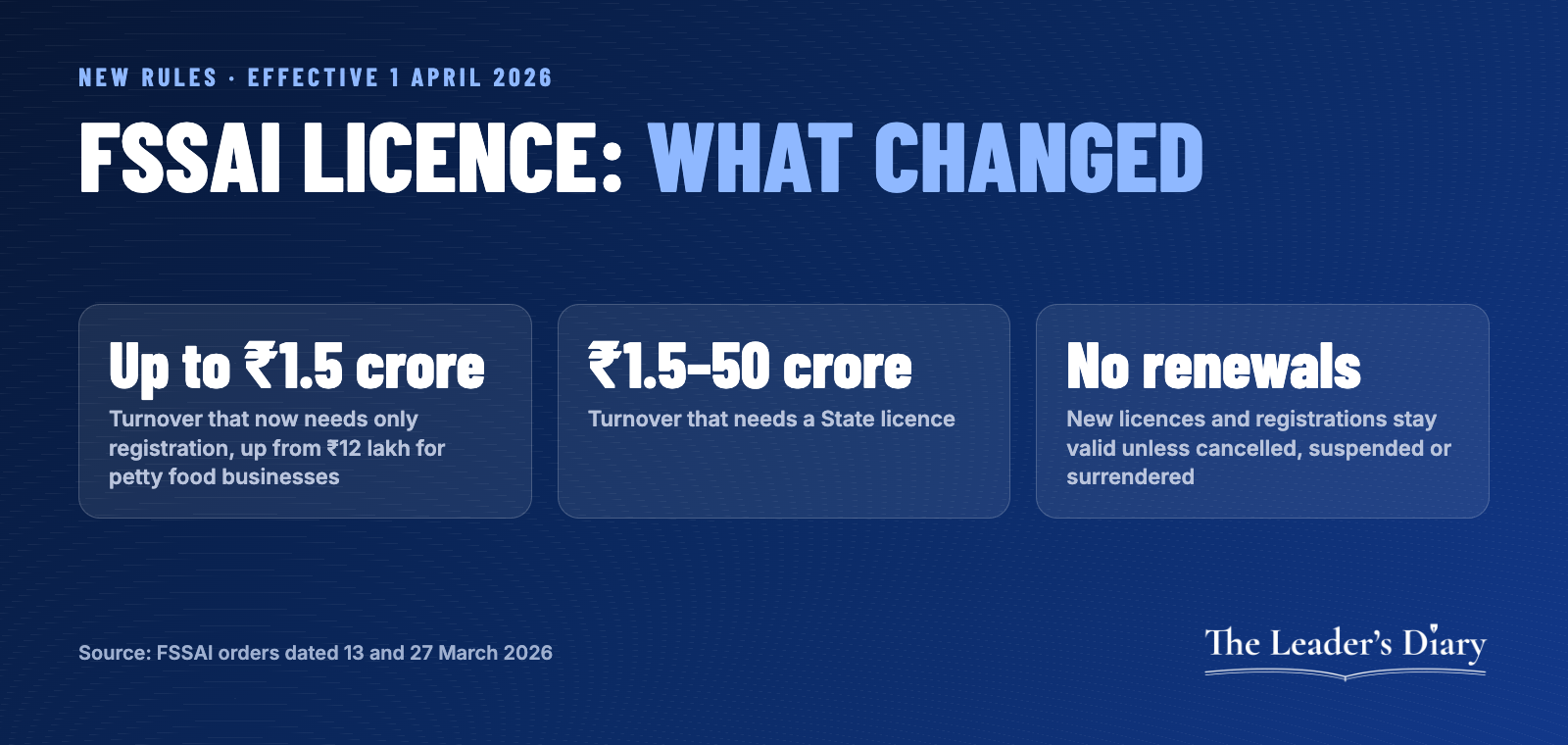
From 1 April 2026, a food business with annual turnover up to ₹1.5 crore needs only an FSSAI registration, a State licence covers turnover from ₹1.5 crore to ₹50 crore, and a Central licence is for turnover above ₹50 crore. Licences and registrations issued on or after that date no longer need to be renewed: they stay valid unless they are suspended, cancelled or surrendered.
If you run or plan to run a tea stall, sweet shop, tiffin service, bakery, cafe or restaurant, this changes which licence you apply for and how often you deal with FSSAI. Below is what the new rules say, in plain language, taken from FSSAI's own orders. Many guides online still quote the old limits, so check the date on anything you read.
What changed from 1 April 2026
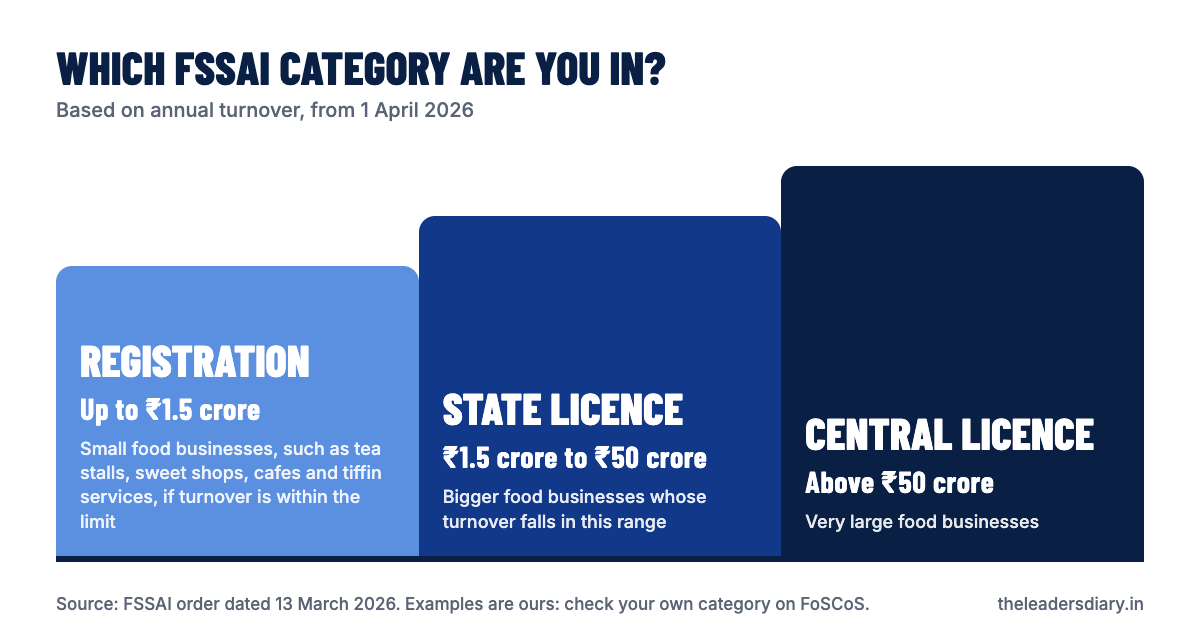
FSSAI's order of 13 March 2026 revised the turnover limits that decide whether a food business needs a registration, a State licence or a Central licence. It says the new limits replace all earlier orders on the subject.
| Type | Annual turnover |
|---|---|
| Registration | Up to ₹1.5 crore |
| State licence | Above ₹1.5 crore, up to ₹50 crore |
| Central licence | Above ₹50 crore |
For comparison, an FSSAI eligibility schedule published on its FoSCoS portal (it carries no date) listed the registration limit for petty food businesses, such as tea stalls, sweet shops, juice stalls and snack stalls, as annual turnover up to ₹12 lakh, with a registration fee of ₹100 a year. The new limit of ₹1.5 crore is more than twelve times higher. Check the FoSCoS portal for the fee that applies now, because the new orders do not state fees.
No more renewals
The Food Safety and Standards (Licensing and Registration of Food Businesses) Amendment Regulations, 2026, notified on 10 March 2026, introduced "perpetual validity". According to FSSAI's FAQ of 27 March 2026:
- Licences and registrations issued on or after 1 April 2026 stay valid unless they are suspended, cancelled or surrendered. You do not need to renew them.
- You can pay the fee for any number of years at once, at any time of the year.
- This also applies to Tatkal licences and registrations.
- Perpetual validity does not remove your duties. You must still follow the hygiene, safety and other statutory requirements that apply to your business.
If you already have an FSSAI licence
FSSAI says the new limits apply from 1 April 2026 to businesses applying for a new licence or registration on or after that date. Existing businesses will be given "sufficient time" to move to the right category through the FoSCoS portal. According to the FAQ:
- The move happens automatically in the system, based on your own declaration of turnover. No approval from the licensing authority is needed.
- No fee is charged for moving to the new category.
- Your licence or registration number does not change.
- If you hold a State licence but now qualify for registration, the fee you already paid is adjusted against the annual registration fee.
- Applications that were still being processed and are issued on or after 1 April 2026 get perpetual validity.
- Changes to an existing certificate, such as changing details, follow the existing procedure.
The licensing authority's jurisdiction does not change.
Street food vendors, carts and food trucks
The 2026 amendment removes the need for dual registration and dual fees for street food businesses. Vendors, hawkers, food carts, food trucks and similar businesses that are registered under the Street Vendors (Protection of Livelihood and Regulation of Street Vending) Act, 2014 are treated as deemed registered under the Food Safety and Standards Act, 2006. They must still follow the hygiene and sanitary requirements in Schedule 4 of the licensing regulations.
Fewer inspections if you follow the rules
FSSAI is moving to a risk-based inspection system. FSSAI describes it as computer-assisted, using inputs such as your compliance history in inspections and surveillance, your own compliance testing and third-party audits. The aim is to reduce repeat inspections of compliant businesses and focus on those that repeatedly break the rules. FSSAI also says that, with these reforms, more than 98% of food businesses fall under the State government's purview for monitoring, inspection and quality control.
A simple checklist
- Work out your annual turnover. It decides your category: registration, State licence or Central licence.
- Apply or migrate on FoSCoS (foscos.fssai.gov.in), FSSAI's official portal. New applicants choose the category that matches their turnover. Existing holders will be moved to the right category on their own declaration.
- Decide how many years of fee to pay in one go, since there is no renewal to remember.
- Follow the hygiene and safety rules for your type of business. For street vendors and carts, that means Schedule 4 of the licensing regulations.
- Keep your turnover in view. If it grows past a limit, your category may change.
FSSAI is only one of your licences
This article covers FSSAI only. Depending on your city, state and type of business, you may also need other registrations, such as GST (depending on your turnover), a shop and establishment registration and municipal or trade permissions. Those rules differ from place to place, so ask your municipal corporation or a local chartered accountant. You can estimate how your costs affect your profit with our break-even calculator and work out GST on your prices with our GST calculator.
Questions people ask
Does an FSSAI licence expire now?
Not if it was issued on or after 1 April 2026. It stays valid unless suspended, cancelled or surrendered, though you still have to follow the hygiene and safety rules.
What is the turnover limit for FSSAI registration in 2026?
Up to ₹1.5 crore a year. Above ₹1.5 crore and up to ₹50 crore needs a State licence, and above ₹50 crore a Central licence.
I got my licence before April 2026. What should I do?
FSSAI says existing businesses will be moved to the right category through FoSCoS, based on their own declaration, with no fee and no change in licence number. Watch for instructions on the portal.
Do I need approval to move to a different category?
No. FSSAI says the move happens automatically in the system based on your self-declaration and needs no approval from the licensing authority.
Do street food vendors need a separate FSSAI registration?
Vendors registered under the Street Vendors Act, 2014 are treated as deemed registered under the Food Safety and Standards Act. They still have to meet the Schedule 4 hygiene requirements.
How much is the FSSAI fee?
The new orders do not give fee amounts. An earlier FSSAI schedule listed ₹100 a year for registration. Check FoSCoS for the current fee for your category.
Running a food business? Share your experience
If you have applied for or migrated an FSSAI licence under the new rules, tell us how it went. We would like to share real owners' experiences.
This article explains FSSAI's published orders and is not legal advice. Rules can change, so check the FSSAI website and the FoSCoS portal, or ask a professional, before you apply.
Sources
- FSSAI, Order dated 13 March 2026: Implementation of revised turnover threshold for food businesses
- FSSAI, FAQs on the Licensing and Registration Amendment Regulations, 2026 (27 March 2026)
- FSSAI FoSCoS, Kind of business, eligibility and fees (earlier schedule, undated)
- FoSCoS: FSSAI's licensing and registration portal
Figures are estimates and vary by city, size and season. Last reviewed: 14 Oct 2026.