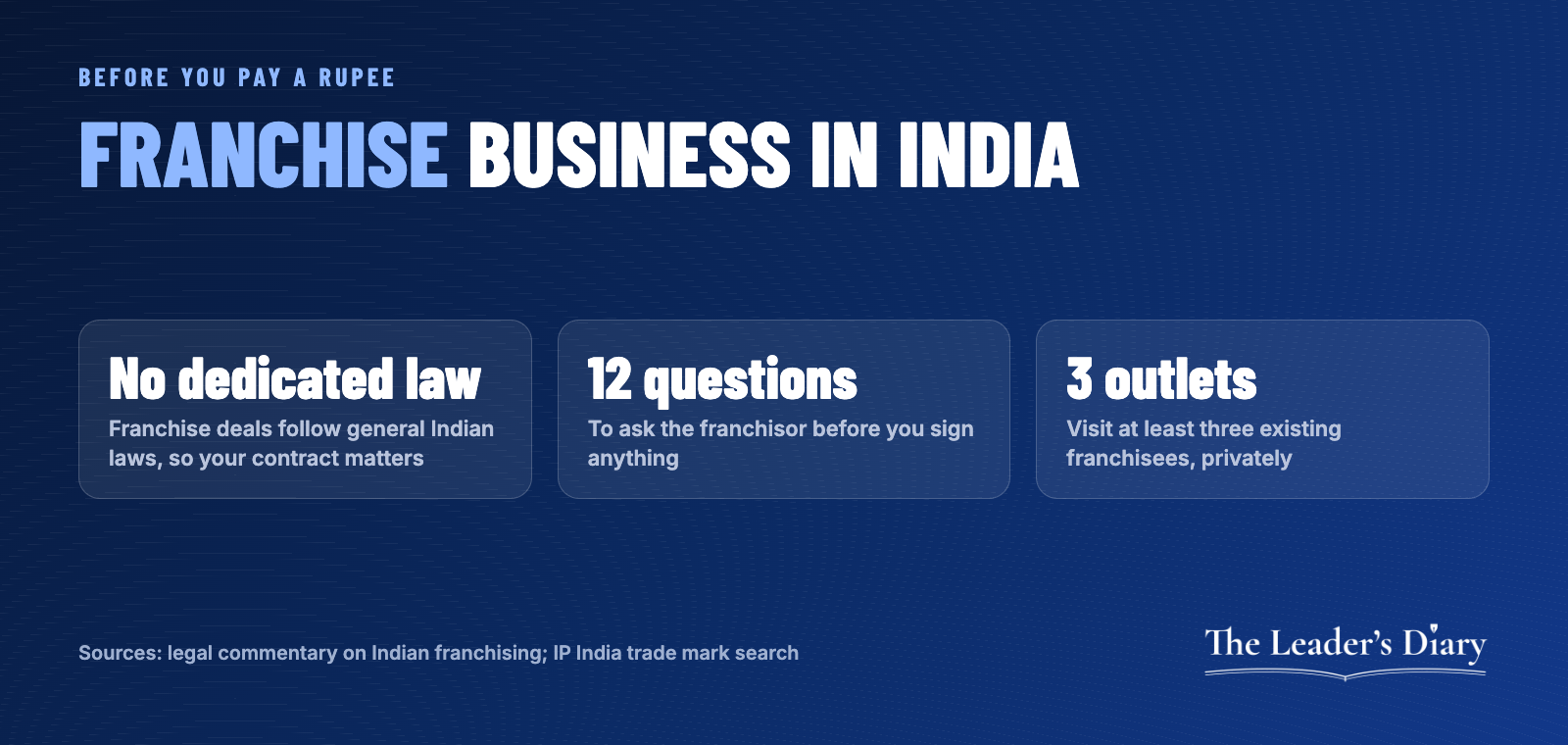
By the numbers
- Dedicated franchise law
- None, according to legal commentary
- Disclosure document
- Not legally required
- Trademark check
- IP India public search
- Questions to ask
- 12
- Outlets to visit
- At least 3
- Please note
- The legal points come from published legal commentary, not from a government notice. This article does not recommend any brand and is not legal advice. Have a lawyer read any agreement before you sign.
Key takeaways
- India has no dedicated franchise law, and franchisors are not legally required to give a disclosure document, so ask for the facts in writing
- Visit at least three outlets, check the brand's trademark and have a lawyer read the agreement
- Work out payback using profit after all fees, not sales: total investment divided by monthly profit
A franchise lets you run a business under an existing brand and system in return for fees. India has no dedicated franchise law, so your protection comes mainly from the agreement you sign and from the checks you do before signing. Before you pay anything, work out every cost in writing, visit existing outlets, check the brand's trademark, have a lawyer read the agreement, and calculate how long it will take you to get your money back.
This guide explains how franchising works, where your money goes, what the law says, 12 questions to ask the franchisor, and the warning signs to watch for. It does not recommend any brand, and it does not promise returns, because no honest source can.
How a franchise works
In a franchise there are two parties. The franchisor owns the brand and the way of doing business, such as recipes, processes, training and suppliers. The franchisee (you) pays to use them and runs an outlet. In return, you usually pay a one-time fee at the start and then regular payments, and you agree to follow the franchisor's rules on how to run the outlet.
The attraction is a known name and a ready system, which can save you time. The risk is that you pay for them whether or not your outlet makes money, and you give up some control.
Where your money goes
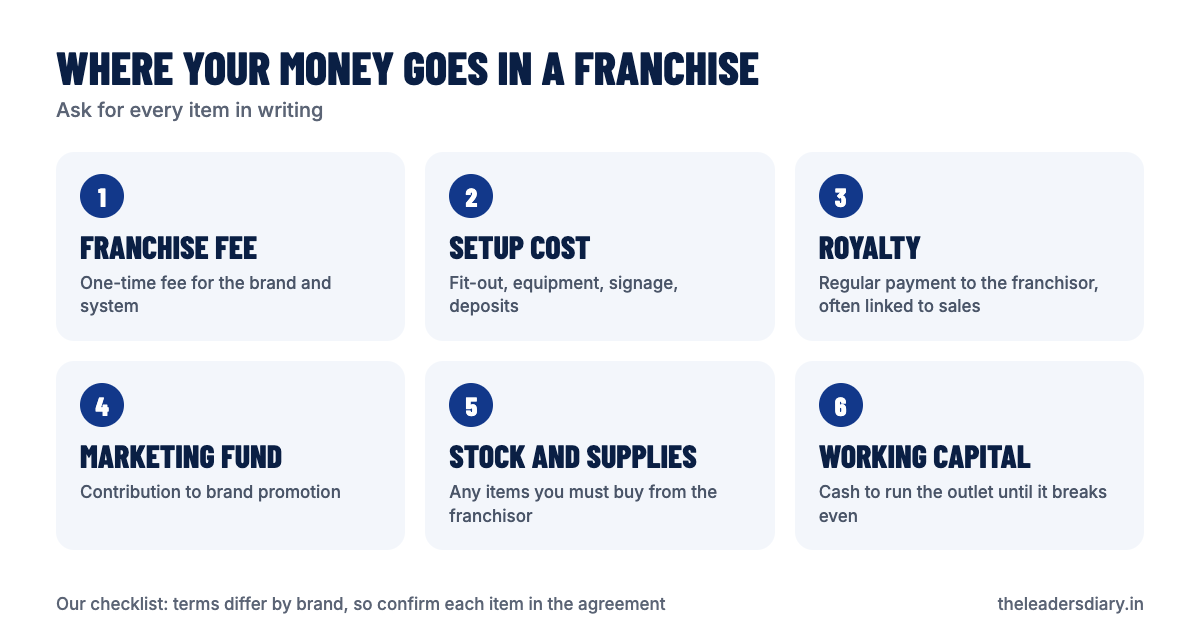
| Cost head | Questions to ask |
|---|---|
| Franchise fee | How much, and is any of it refundable? |
| Setup cost | Who chooses the contractor and equipment? Is the price fixed? |
| Royalty | Is it a share of sales or a fixed fee, and how often is it paid? |
| Marketing fund | How much do you pay in, and what do you get back? |
| Stock and supplies | Must you buy from the franchisor, and at what margin? |
| Renewal and transfer fees | What do you pay to renew the agreement or sell the outlet? |
| Working capital | How much cash will you need before the outlet breaks even? |
What the law says in India
According to legal commentary on Indian franchising, there is no dedicated franchise statute. Franchise arrangements are governed by general laws instead. Commentators point to the Indian Contract Act (the basic rules for agreements), the Trade Marks Act (protection of the brand) and the Competition Act (limits on certain restrictive terms), and for foreign franchisors, the foreign exchange rules under FEMA. The same commentary notes that India does not legally require franchisors to give a franchise disclosure document, although providing one is common practice. See the legal guide linked in the sources below.
What this means for you: nobody is forcing the franchisor to show you the facts, so you must ask for them and check them yourself. Treat the written agreement as the main protection you have, and have a lawyer who knows commercial contracts read it before you sign.
12 questions to ask the franchisor
- What is the total investment, item by item, including every fee and deposit?
- What are the royalty and marketing contributions, and how are they calculated?
- How many outlets are open, and how many have closed in the last three years?
- Can I speak to franchisees you did not choose for me, including closed ones?
- What do outlets like mine actually earn? Are the figures audited, and what assumptions are behind them?
- Is the brand's trademark registered, and who owns it?
- What territory am I given, and will you open another outlet close to mine?
- What training and ongoing support will I get, and for how long?
- Must I buy supplies from you or approved suppliers, and are the prices fixed?
- How long is the agreement, what does renewal cost, and can I sell the outlet?
- What happens if either of us wants to leave early, and what do I get back?
- Which licences does the outlet need, and who is responsible for getting them?
How to check the brand yourself
- Visit at least three outlets, and pick some yourself. Watch the footfall, then speak to the owners privately, away from the franchisor.
- Check the trademark. The Trade Marks Registry's public search on the IP India website lets you look up whether a brand name is registered or applied for, and in whose name.
- Ask for the franchisor's financial statements and look for losses, debts and legal disputes.
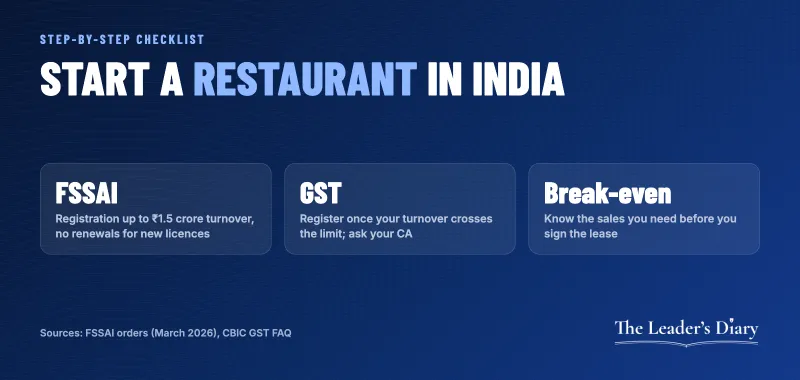
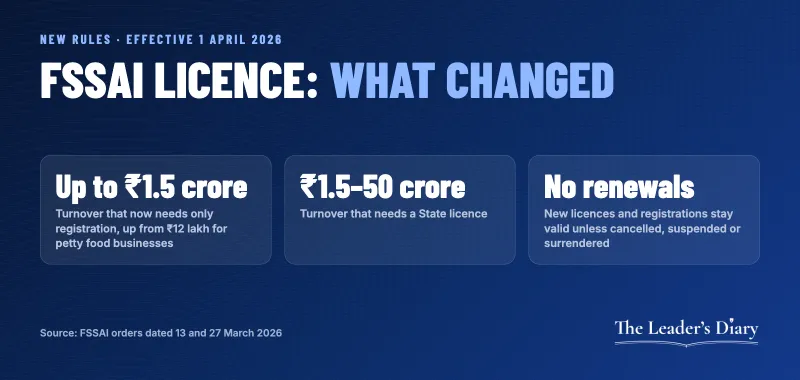
- Check licences. If it is a food brand, an outlet should hold an FSSAI registration or licence. Our guide to the new FSSAI rules explains what applies.
- Search news and court records for complaints from franchisees.
Warning signs
- Guaranteed or very high returns, or income "projections" with no assumptions.
- Pressure to pay a deposit quickly "before the offer ends".
- Refusing to let you meet other franchisees, or only showing you their chosen ones.
- A brand with no registered trademark or no clear owner.
- Vague territory, or no promise that they will not open nearby.
- Large compulsory purchases from the franchisor at high prices.
- No clear exit terms, and nothing in writing about what you get back.
Work out your payback before you sign
Payback is how long it takes for your outlet's profit to return your investment: total investment ÷ monthly profit after all fees and costs. The key is to use profit after royalty, marketing fund, rent, salaries and every other cost, not sales.
An illustration (the numbers are invented to show the method, not a benchmark): if your total investment is ₹20,00,000 and your outlet earns ₹50,000 a month after all costs, the payback is ₹20,00,000 ÷ ₹50,000 = 40 months. If the franchisor's claim sounds faster than that, ask what costs they left out. Use our break-even calculator to see what sales your outlet needs to cover its costs.
Franchise or your own brand?
| Franchise | Your own brand | |
|---|---|---|
| Brand recognition | Ready-made, if the brand is known in your area | You build it from nothing |
| Systems and training | Provided by the franchisor | You create them |
| Control | Limited by the agreement | Full |
| Ongoing payments | Royalty and other fees | None to a brand owner |
| Risk | Depends on the brand and your contract | Depends on your idea and execution |
If you are thinking of starting your own food business instead, read our restaurant business checklist.
Questions people ask
Is a franchise safer than starting my own business?
Not automatically. A good brand and a fair agreement can reduce risk, but you still carry the cost of the outlet and the location, and you pay fees whether or not you make a profit.
What is a royalty in a franchise?
It is a regular payment to the franchisor for using the brand and system. It is often linked to your sales, but the exact method is set out in the agreement.
Do I need a lawyer to buy a franchise?
We strongly recommend it. India has no dedicated franchise law and no legal requirement for a disclosure document, so the written agreement and your own checks are your main protection.
Can I franchise my own business?
You would generally need a brand you own and have protected, a system others can follow, proof that the business makes a profit, and a carefully drafted agreement from a lawyer.
How long does it take to get my money back?
It depends on the brand, the location and the costs. Work it out with your own numbers using the payback method above, and be wary of anyone who promises a fixed time.
Bought a franchise? Share your experience
If you run a franchise outlet, tell us your story, including what it really cost, what the franchisor delivered and what you wish you had asked. We would like to publish real franchisees' experience.
This article is a general guide and not legal, tax or financial advice. It does not recommend any brand. Get professional advice before signing any franchise agreement.
Sources
- Mondaq, Franchising: Comparative Guide, India (law-firm commentary on the legal framework)
- IP India (Trade Marks Registry), public search for registered trade marks
- The payback illustration uses invented round numbers to show the method. It is not a benchmark.
Figures are estimates and vary by city, size and season. Last reviewed: 14 Oct 2026.