By the numbers
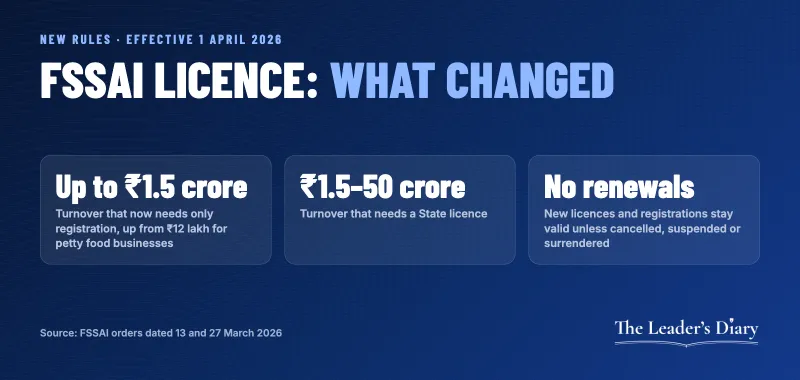
- FSSAI registration
- Turnover up to ₹1.5 crore
- FSSAI State licence
- ₹1.5 crore to ₹50 crore
- FSSAI renewal
- Not needed for new licences
- GST registration (usual limit)
- ₹20 lakh (₹10 lakh in special category states)
- Steps to open
- 6
- Please note
- FSSAI figures are from FSSAI's March 2026 orders and the GST limit is from CBIC's FAQ. Confirm both for your case with a CA, because rules and state lists can change.
Key takeaways
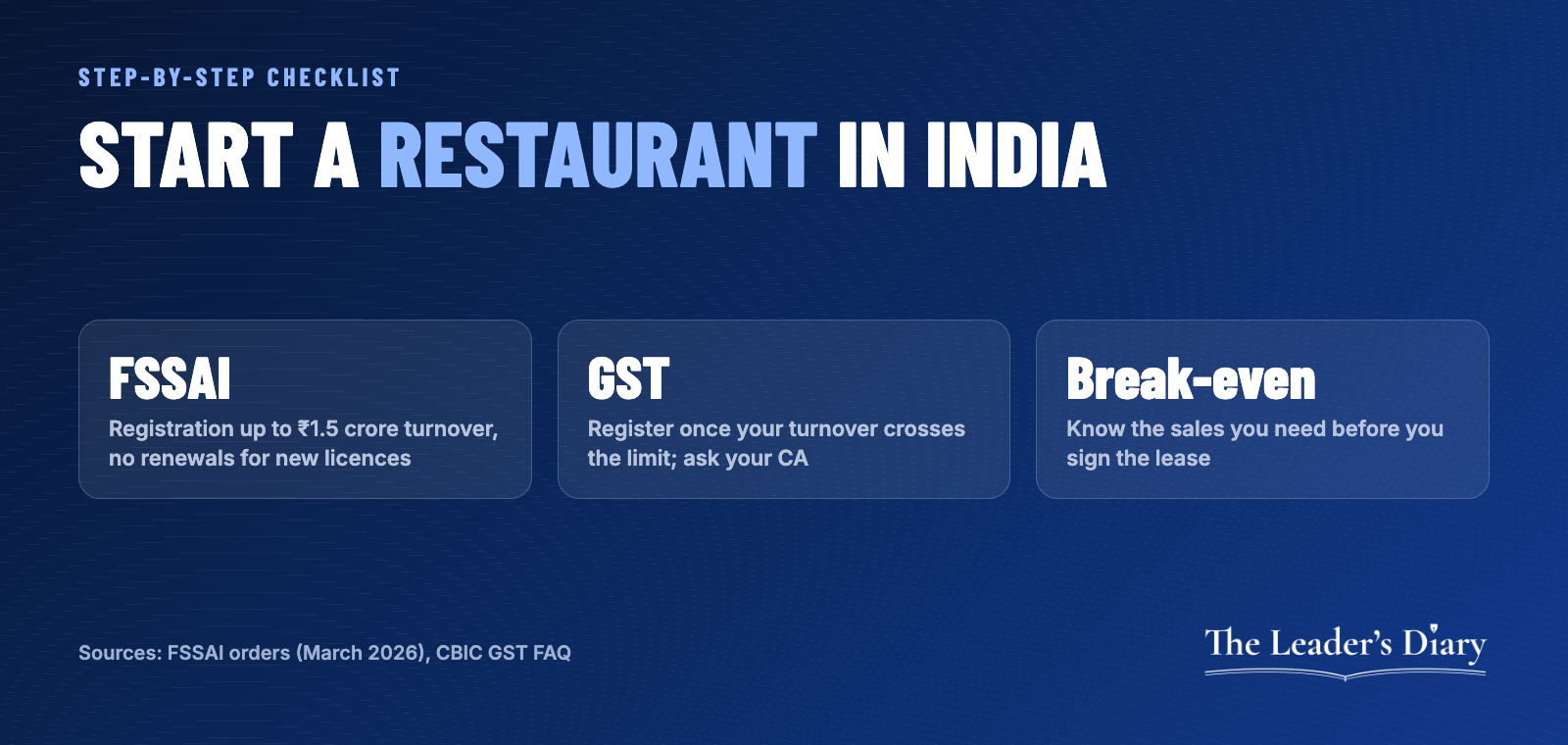
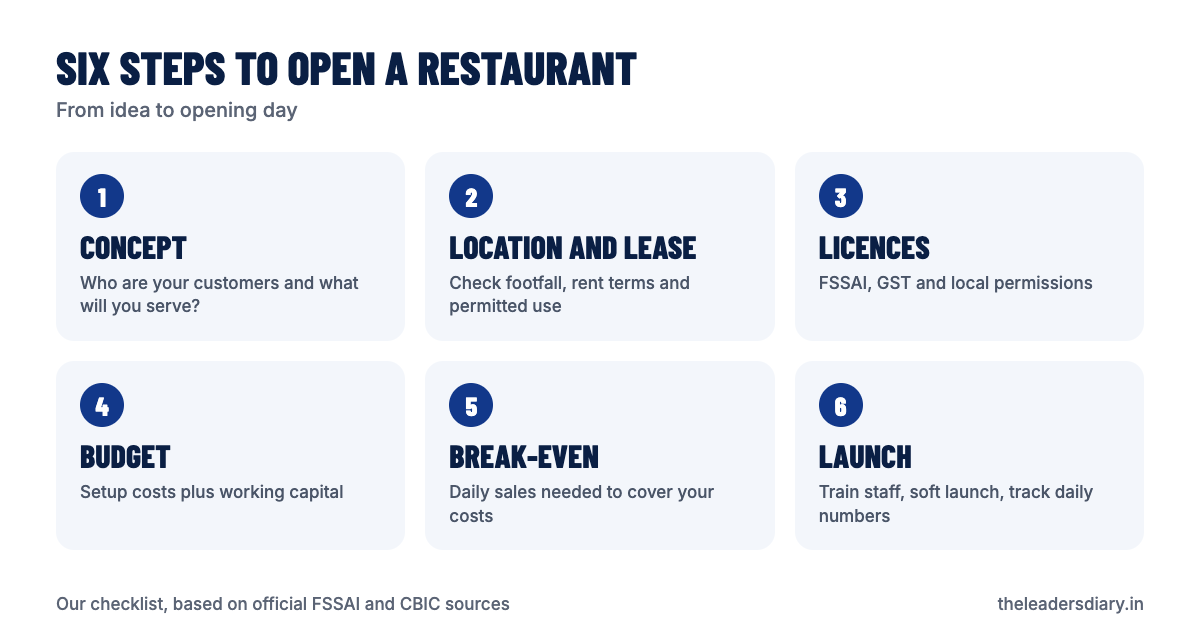
- Work in order: concept, location and lease, licences, budget, break-even, then launch
- FSSAI registration covers turnover up to ₹1.5 crore from 1 April 2026, new licences need no renewal; GST and local permissions depend on your turnover, state and city
- Budget for working capital as well as setup, and know the sales you need before you sign the lease
To start a restaurant in India, work through six steps in this order: choose a concept, pick a location and read the lease carefully, get your licences, budget for setup and for working capital, find your break-even sales, and then launch. The most common mistakes are signing a lease before knowing your numbers and running out of cash before sales catch up with costs.
This guide is a checklist, not a promise of profit. We have not put a single "cost of a restaurant" figure in it, because costs vary enormously by city, size and style, and we do not want to give you a number we cannot back up. Instead you will find the cost heads to budget for, the official rules for FSSAI and GST, and a way to work out your own break-even.
Step 1: Choose a concept that fits your city and budget
A simple concept that you can run well beats a big menu that you cannot. Think about who will eat with you and when: office workers at lunch, families at weekends, students in the evening. Examples of concepts to consider include a pure vegetarian thali restaurant, a South Indian tiffin room, a chaat and sweets counter, a cafe, or a cloud kitchen that serves delivery only.
Before you commit money, test the idea cheaply. Cook for a small group, run a stall or a pop-up for a few weekends, and write down what people order, what they leave and what they would pay.
Step 2: Pick the location and read the lease carefully
Location decides how many people walk past you. Visit at different times of day and on different days, and count the people who pass. Then read the lease with a lawyer or someone who has read many. Check:
- the rent, how it increases and the lock-in period,
- the security deposit and when you get it back,
- whether the premises can legally be used for cooking and serving food,
- ventilation, exhaust, water, drainage and electrical load for a kitchen,
- who pays for repairs, and what happens if you want to leave early.
Step 3: Get your licences
FSSAI (food safety)
Every food business needs an FSSAI registration or licence. From 1 April 2026, registration covers annual turnover up to ₹1.5 crore, a State licence covers turnover above ₹1.5 crore up to ₹50 crore, and a Central licence is for turnover above ₹50 crore. New licences and registrations issued on or after that date do not need to be renewed. We explain the rules, and what existing licence holders should do, in our guide to the new FSSAI licence rules. Apply through FSSAI's FoSCoS portal.
GST
According to CBIC's published FAQ, a supplier has to register for GST once aggregate turnover in a financial year crosses ₹20 lakh, and the limit is ₹10 lakh for special category states. The list of those states differs between CBIC documents, so confirm the limit for your state on the GST portal. GST also depends on the rates the GST Council has set for your kind of service and on how you sell, for example whether you sell through food-delivery apps, which can change your position. Ask a chartered accountant (CA) before you decide. You can work out GST on your prices with our GST calculator.
Local permissions
Depending on your city and state, you may also need some of the following. Rules differ from place to place, so ask your municipal corporation for the full list and the order in which to apply:
- shop and establishment registration,
- a trade or health licence from your municipal body,
- a fire safety clearance, especially for larger premises,
- permission for your signboard,
- an eating-house licence in cities that ask for one,
- a music licence, if you play recorded music in the premises.
Step 4: Budget for setup and for working capital
Most restaurants run into trouble not because the setup cost more than expected, but because there is no cash left to pay rent and salaries while customers are still building up. Budget for both. Ask for written quotes for every item.
| Cost head | What to find out |
|---|---|
| Lease deposit and advance rent | How many months, and when it is returned |
| Fit-out and furniture | Civil work, kitchen layout, seating, lighting |
| Kitchen equipment | New or used, warranty and servicing |
| Licences and registrations | Fees and agent charges for each |
| Opening stock | Ingredients and packaging for the first weeks |
| Staff | Hiring, training and salaries before sales build up |
| Billing and ordering software | Monthly fee and set-up |
| Branding, signage and launch marketing | One-time and ongoing |
| Working capital buffer | Enough to cover fixed costs until you break even |
Step 5: Find your break-even
Your break-even is the sales you need each month to cover all your costs. The method is simple:
- Add up your fixed costs for a month: rent, salaries, electricity, software, loan payments and anything else you pay whether or not customers come.
- Work out your average bill and the variable cost of each bill: ingredients, packaging, delivery and payment charges.
- Subtract: average bill minus variable cost is what each bill contributes towards your fixed costs.
- Divide your fixed costs by that contribution to get the number of bills you need each month.
An illustration (the numbers are invented to show the method, not a benchmark): suppose your fixed costs are ₹4,00,000 a month, your average bill is ₹300 and the variable cost is ₹120 a bill. Each bill contributes ₹180. You need ₹4,00,000 ÷ ₹180, about 2,222 bills a month, or roughly 74 bills a day over 30 days, just to break even. Your own numbers will be different, so use them. Our break-even calculator does this for you.
If the number of bills looks higher than your location can realistically deliver, change the plan before you sign the lease: a smaller space, a higher average bill, lower costs, or a different location.
Step 6: Launch and track your numbers
- Train your staff on hygiene and service before opening. FSSAI expects food businesses to follow the hygiene and safety rules that apply to them.
- Start with a soft launch for friends and neighbours, collect honest feedback, and fix problems before you advertise.
- Track a few numbers every day: bills, average bill, sales, and the cost of ingredients. Compare them with your break-even.
- Keep the menu small at first. You can always add dishes that sell.
- List your restaurant online with correct address, timings and photos.
Common mistakes to avoid
- Signing the lease before working out break-even.
- Spending all your money on the fit-out and having nothing left for the first months.
- A very large menu that raises waste and slows the kitchen.
- Pricing by guesswork instead of working out the cost of each dish.
- Not keeping daily records, so problems show up too late.
- Ignoring licences, which can lead to penalties or closure.
Questions people ask
How much does it cost to start a restaurant in India?
It depends too much on the city, the size and the style for us to give one honest figure. Use the cost heads above, get written quotes locally, and add a working-capital buffer. If you have started a restaurant and are willing to share your real numbers, we would like to hear from you.
Is an FSSAI licence compulsory for a restaurant?
Every food business needs an FSSAI registration or licence. Which one depends on your annual turnover: registration up to ₹1.5 crore, a State licence above that up to ₹50 crore, and a Central licence above ₹50 crore, from 1 April 2026.
Do I need GST registration for a restaurant?
It depends on your turnover, your state and how you sell. CBIC's FAQ gives ₹20 lakh as the general limit for suppliers and ₹10 lakh for special category states. Confirm the current rules for your case with a CA.
How do I know if my restaurant will make a profit?
Work out your break-even sales and check whether your location can realistically reach it. Then track your daily numbers against it.
Run a restaurant? Share what you learned
If you have opened a restaurant or a cafe, tell us your story, including what it really cost and what you would do differently. We would like to publish real owners' experience alongside this guide. See also our guide to franchise business in India if you are thinking of buying into an existing brand.
This article is a general guide and not legal, tax or financial advice. Rules differ by city and state and can change, so confirm with your municipal corporation, a CA and a lawyer before you commit.
Sources
- FSSAI, Order dated 13 March 2026: Implementation of revised turnover threshold for food businesses
- FSSAI, FAQs on the Licensing and Registration Amendment Regulations, 2026 (27 March 2026)
- CBIC, Frequently Asked Questions on GST (registration threshold)
- FSSAI FoSCoS, licensing and registration portal
- The illustration in Step 5 uses invented round numbers to show the method. It is not a benchmark.
Figures are estimates and vary by city, size and season. Last reviewed: 14 Oct 2026.