By the numbers
- Founder named on website
- Chandubhai Virani
- Started making wafers
- 1981 (journey page) or 1982 (blog)
- Starting loan
- ₹20,000 (company blog)
- Products in 2019
- 65+
- Dealers in 2019
- 1,225+
- Annual sales
- Over ₹5,000 crore (year to March 2023)
- Please note
- All facts are from Balaji Wafers' own website. The sales figure is the company's claim, and its pages disagree on some early dates, shown in a table in the article.
Key takeaways
- The Virani family sold its ancestral land, lost a first business, then ran the canteen at Astron Cinema in Rajkot
- They began making their own wafers (1981 per the company's journey page, 1982 per its blog) after customers disliked the supplier's
- The company says annual sales crossed ₹5,000 crore in the year to March 2023; its own pages differ on some early dates
In the early 1970s, a farming family in a drought-hit Gujarat village sold its ancestral land. A few years later, Balaji Wafers' own history says, a business venture with the money from that sale ended in deceit, and they lost everything. They took odd jobs at a cinema in Rajkot, ended up running its canteen, and in 1981 began making their own wafers. By the year ending March 2023, according to the company, Balaji Wafers had crossed ₹5,000 crore in annual sales.
This is the story of the Virani family and Balaji Wafers, told from the company's own pages. We also point out where those pages disagree with each other, which is rare in a company story and worth knowing about.
From selling the family land to a cinema canteen
According to the company's "Our Journey" page, the Virani family was forced to sell its ancestral land in a drought-stricken village because it no longer supported their livelihood. With the proceeds they tried the agricultural equipment business, but "were met with deceit and lost everything."
In 1974, it says, "fate led them to Astron Cinema", where they took odd jobs such as hanging posters and making sandwiches for moviegoers, and were in time entrusted with the canteen. The company's blog says that Chandubhai Virani, then a young boy who had moved to Rajkot with his family, got a job at the cinema's canteen. Chandubhai Virani is named on the company's website as its founder.
The idea: make better wafers than the supplier's
While running the canteen, the page says, the brothers noticed that moviegoers were not satisfied with the wafers from their supplier, so they decided to make their own and call them "Balaji Wafers". Their first factory was a small room behind the cinema, according to the company's blog, which says they started with a ₹20,000 loan and had no large equipment and no flashy packaging, "just properly salted chips and a lot of hustling".
By 1984, the journey page says, "with bare hands and boundless drive" they fried wafers and also supplied nearby retailers, and people queued to buy packs.
How it grew
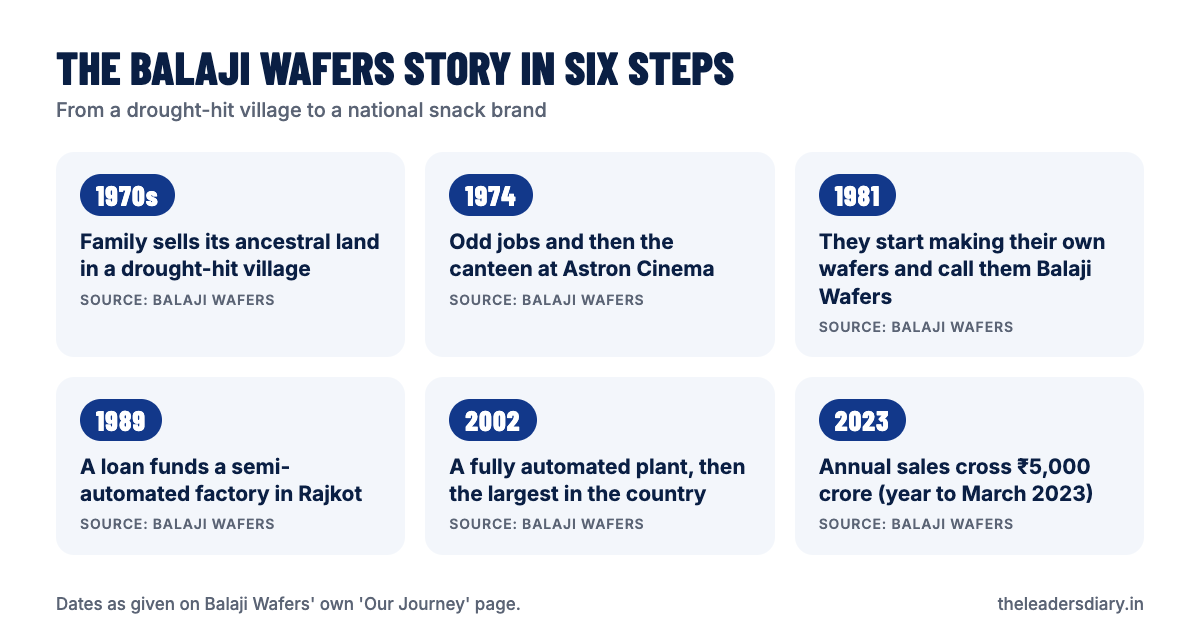
- 1989: Demand grew, so they took a loan and built a semi-automated factory in Rajkot, to get a consistent crunch and hygiene.
- 1995: Balaji Wafers became a private limited company, with a fully automated factory and a new range of Indian namkeen.
- 2002: They invested in a fully automated factory in Rajkot, the largest in the country at the time, according to the company.
- 2008: A plant in Valsad, described as one of the biggest in Asia at the time, with more units for namkeen.
- 2015: A hi-tech plant in Indore, to serve the north and west of India.
- 2019: More than 65 products and more than 1,225 dealers.
- 2023: Annual sales above ₹5,000 crore in the financial year ending March 2023.
The company's homepage describes its products as a range of wafers, namkeen, western snacks, noodles and confectionery, and highlights "fully automated factories" and "uncompromising quality".
Where the company's own pages disagree
The "Our Journey" page and a May 2025 blog post on the same website tell the story slightly differently. We have used the "Our Journey" page for the main timeline, and list the differences here so you can judge for yourself:
| Event | "Our Journey" page | Company blog (May 2025) |
|---|---|---|
| Wafer-making begins | 1981 | 1982 |
| Starting loan | Not stated | ₹20,000 |
| Becomes a private limited company | 1995 | 1992 |
| Semi-automated production | 1989 | 1996 |
| Fully automated plants | 2002 (Rajkot) | 2008 (Rajkot and Valsad) |
Neither page gives a profit figure, and the sales figure is the company's own claim, not an audited number we have checked. The company's website also lists an "Annual Returns" page, which is where official filings may be found.
Five lessons from the Balaji story (our analysis)
- Start where you stand. They did not start in an office. They noticed a problem in the place where they already worked: customers disliked the wafers on sale.
- Solve a small, real problem. A better, fresher wafer for the people queuing in front of them was enough to begin.
- Lose, then rebuild. The family lost its land and its first business before this one. The cinema job was a restart, not a first try.
- Invest in consistency. Each time demand rose, the company's own account says it spent on machines for hygiene and a consistent crunch.
- Grow in steps. One factory, then a bigger one, then plants in other states, each following proven demand.
If you want to make food for sale
- Start by serving a small group, and watch what they say.
- Work out your costs and what you must sell with our break-even calculator.
- Check licence rules before you sell. Our guide to the new FSSAI rules explains registration and licences.
Questions people ask
Who founded Balaji Wafers?
The company's website names Chandubhai Virani as its founder, and its journey page credits the Virani brothers.
Where did Balaji Wafers start?
In Rajkot, Gujarat, from the canteen at Astron Cinema, according to the company.
How much did it start with?
The company's blog says a ₹20,000 loan. Its "Our Journey" page does not state an amount.
How big is Balaji Wafers today?
The company says it crossed ₹5,000 crore in annual sales in the year ending March 2023. We have not found a more recent figure on its website.
Know a story like this?
If you started small and grew a food business, tell us your story.
This article is compiled from the company's public website and is not affiliated with or endorsed by Balaji Wafers. Figures are the company's own claims and may have changed. The lessons are our own analysis.
Sources
- Balaji Wafers, Our Journey (company website)
- Balaji Wafers, From Cinema Canteen to Snack Empire (company blog, 12 May 2025)
- Balaji Wafers, homepage (founder's statement, 2023 sales milestone)
- Cover photo: Jiafei Slay Queen, "Wavy potato chips" (Wikimedia Commons, CC0)
- The five lessons are our own analysis. This article is not affiliated with Balaji Wafers.
Figures are estimates and vary by city, size and season. Last reviewed: 15 Oct 2026.