By the numbers
- Incorporated
- 29 November 1978
- Starting team
- 3 employees, rented shed in Koramangala
- First export
- Papain (from papaya), 1979
- Became independent
- 1998
- Listed
- March 2004 (bids 33 times the offer)
- Enzymes business sold
- 2007, for USD 115 million
- Please note
- All facts are from Biocon's own 'Our Legacy' page. 'First in the world' claims are the company's, not independently checked.
Key takeaways
- Biocon was incorporated on 29 November 1978 with three employees in a rented shed in Koramangala, Bengaluru
- Its first export, in 1979, was papain, an enzyme from papaya; in 1998 Kiran Mazumdar-Shaw and John Shaw bought out Unilever's share
- It listed in March 2004, with bids 33 times the shares offered, and sold its enzymes business in 2007 to focus on biopharmaceuticals
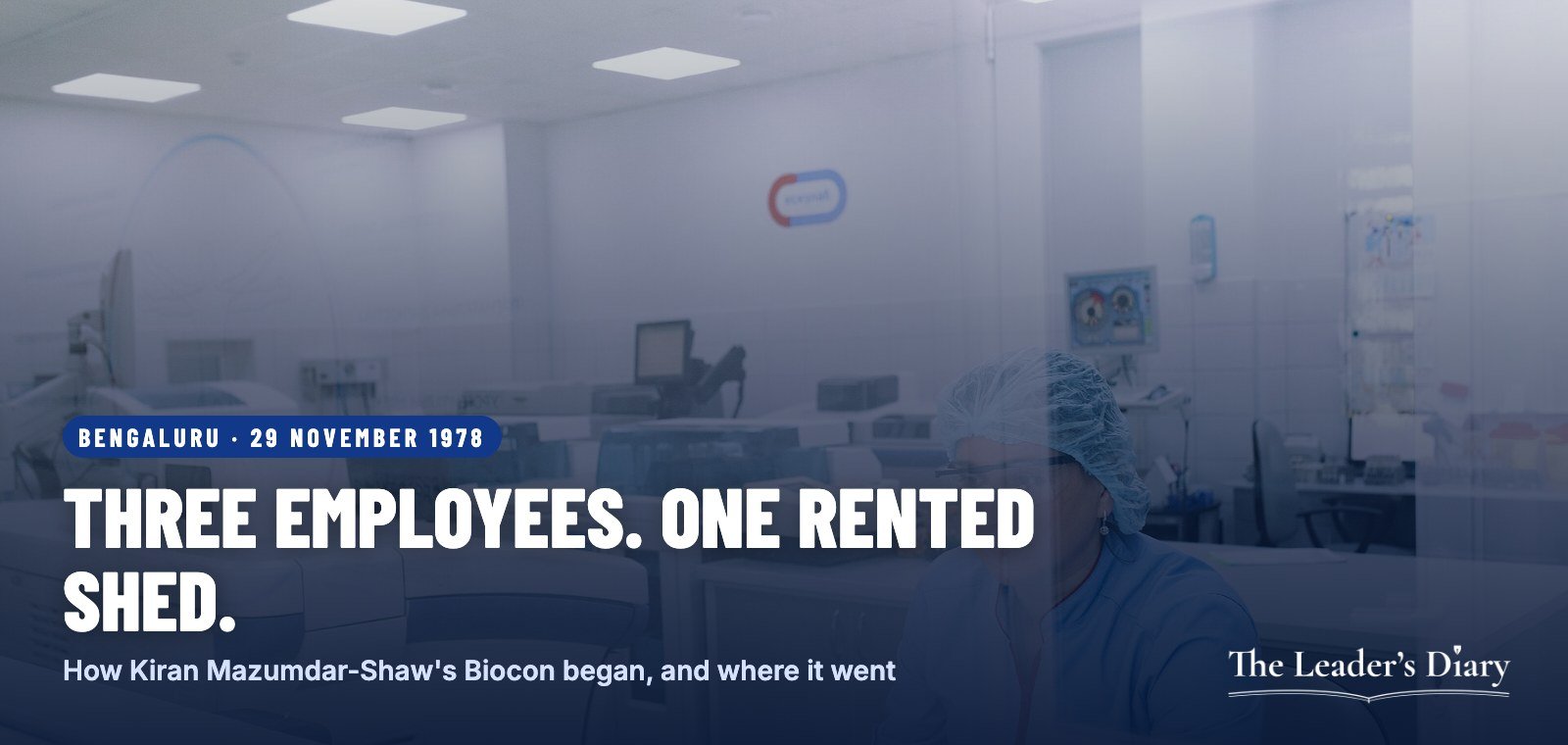
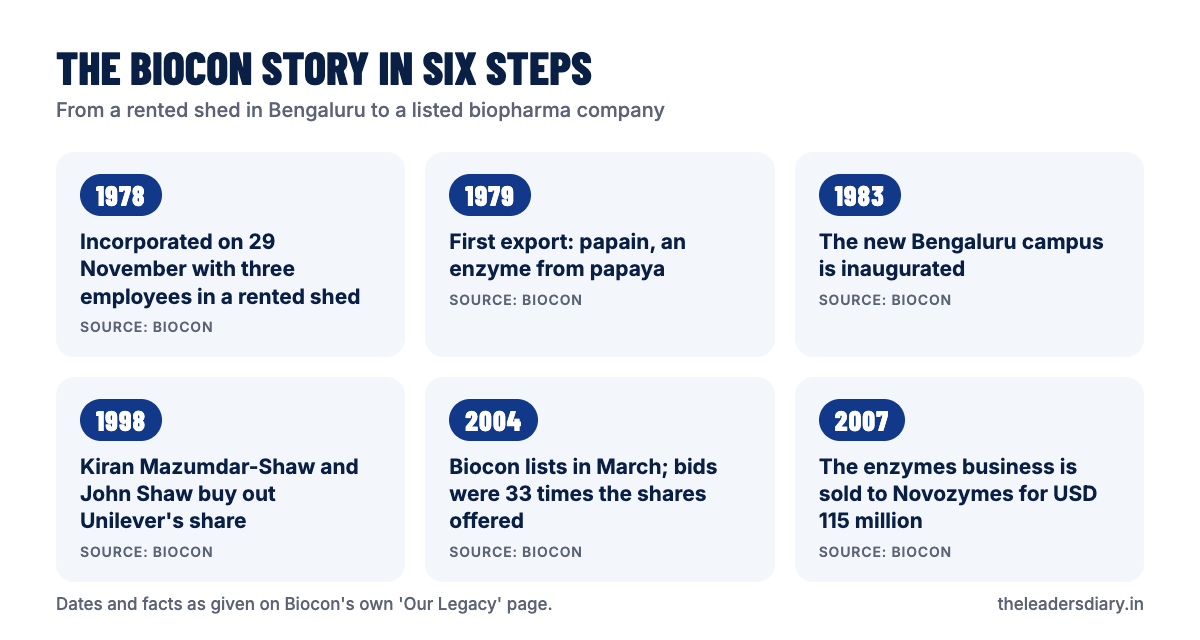
On 29 November 1978, Biocon India was incorporated in Bengaluru as a joint venture between Kiran Mazumdar-Shaw and an Irish company. According to Biocon's own history page, it began with three employees in a rented shed in Koramangala. In March 2004 it listed on the stock exchanges, and bids in its public offer were 33 times the number of shares on offer. This is the story of how a small enzyme business became one of India's best-known biopharmaceutical companies, told mainly from the company's own timeline.
How it began: a rented shed and an enzyme from papaya
Biocon says it was incorporated as a joint venture between Kiran Mazumdar-Shaw and Biocon Biochemicals Ltd, Ireland, starting with three employees in a rented shed in Koramangala, then a suburb of Bengaluru. It began making and exporting enzymes. Its first export, in 1979, was papain, a plant enzyme derived from papaya, sold to the US and Europe. The company says this showed its ambition "to produce high quality, world class products in India for global markets".
Within two years it had bought a 20-acre plot on Hosur Road for ₹6,00,000, according to its timeline, and on 8 March 1980 the foundation stone was laid for the building that now houses its corporate office. The new campus was inaugurated on 2 November 1983, and research and development began there.
Building the science
- 1984: A research division was set up, at first to develop solid state fermentation technology for new enzymes.
- 1989: Unilever acquired Biocon's Irish parent company, and Biocon India began making enzymes for Unilever's food businesses.
- 1993: Its research and manufacturing facilities received ISO 9001 certification, which Biocon describes as a first for a life sciences company in India.
- 1998: Kiran Mazumdar-Shaw and John Shaw bought out Unilever's share, making Biocon an independent, privately owned company.
- 2000 and 2001: Biocon commissioned a patented fermentation reactor and a fully automated fermentation plant, and says it was the first company globally to get US FDA approval for making the drug ingredient lovastatin using solid state fermentation.
- 2004: It says it became the first company in the world to commercialise recombinant human insulin made with a yeast called Pichia pastoris, sold as Insugen. Its insulin is now approved in over 40 countries, according to the company.
The 2004 listing
Biocon's page says it listed in March 2004 with a very successful public offer. Bids were 33 times the 1 crore shares available. On the first day of trading it closed with a market value of USD 1.1 billion, which it says made it only the second Indian company to cross USD 1 billion on its first day of listing.
Changing what the company does
In 2007 Biocon sold its older enzymes business to Novozymes for USD 115 million so it could focus on developing and making biopharmaceuticals. In 2009 it announced a partnership with the US company Mylan to develop biosimilars, which are close copies of existing biological medicines, and launched an insulin glargine in India. Today Biocon describes itself as "a global biopharmaceutical company changing patients' lives in over 120 countries" by finding new and affordable ways to treat diabetes, cancer and autoimmune diseases.
What we could not confirm
- How much money Kiran Mazumdar-Shaw started with. Biocon's history page does not state it, and we have not used figures from other sources.
- The company's current size and finances. Biocon's annual reports and investor pages are the place for those.
- Claims such as "first in the world" are Biocon's own, and we have not verified them independently.
Five lessons from the Biocon story (our analysis)
- Start small and start exporting. Its first export came the year after it began, with a single product.
- Build your own capability. It added a research division within six years and kept investing in its own technology.
- Quality certificates open doors. It sought ISO certification early, which helps when selling abroad.
- Be ready to let go of what built you. It sold its enzymes business in 2007 to focus on a harder field.
- Take ownership when you can. The 1998 buyout made the company independent.
If you want to build something technical from scratch
- Pick one product and get one customer, even a faraway one.
- Use our break-even calculator to see what you need to sell to cover costs.
- Read about licences before you make or sell regulated products. Our guide to the new FSSAI rules covers food businesses.
Questions people ask
When was Biocon founded?
It was incorporated on 29 November 1978, which Biocon calls its founding day.
Where did Biocon start?
In a rented shed in Koramangala, a suburb of Bengaluru, with three employees.
What was Biocon's first product?
According to the company, it began making enzymes, and its first export in 1979 was papain, derived from papaya.
When did Biocon become independent?
In 1998, when Kiran Mazumdar-Shaw and John Shaw bought out Unilever's share.
When did Biocon list on the stock exchange?
In March 2004, according to its own timeline.
Know a story like this?
If you started a technical or science-based business, tell us your story.
This article is compiled from Biocon's public website and is not affiliated with or endorsed by Biocon. Figures are the company's own claims and may have changed. The lessons are our own analysis and this is not investment advice.
Sources
- Biocon, Our Legacy: company history and milestones
- Biocon, About Us
- Cover photo: Esculab, "Scientist in a laboratory Esculab" (Wikimedia Commons, CC0)
- The five lessons are our own analysis. This article is not affiliated with Biocon.
Figures are estimates and vary by city, size and season. Last reviewed: 15 Oct 2026.