By the numbers
- Born
- 1961, Roperkheda village, Akola
- Tailoring and furniture start
- With government loans (per Wikipedia)
- Kamani Tubes founded
- 1959
- Production stopped
- Over 17 years (company website)
- Takeover
- 2001 (Wikipedia) or 2006 (company)
- Padma Shri
- 2013, trade and industry
- Please note
- Sources are Kamani Tubes' website and Wikipedia, which differ on the takeover year. Her net-worth figure is her own estimate and is not repeated here as fact.
Key takeaways
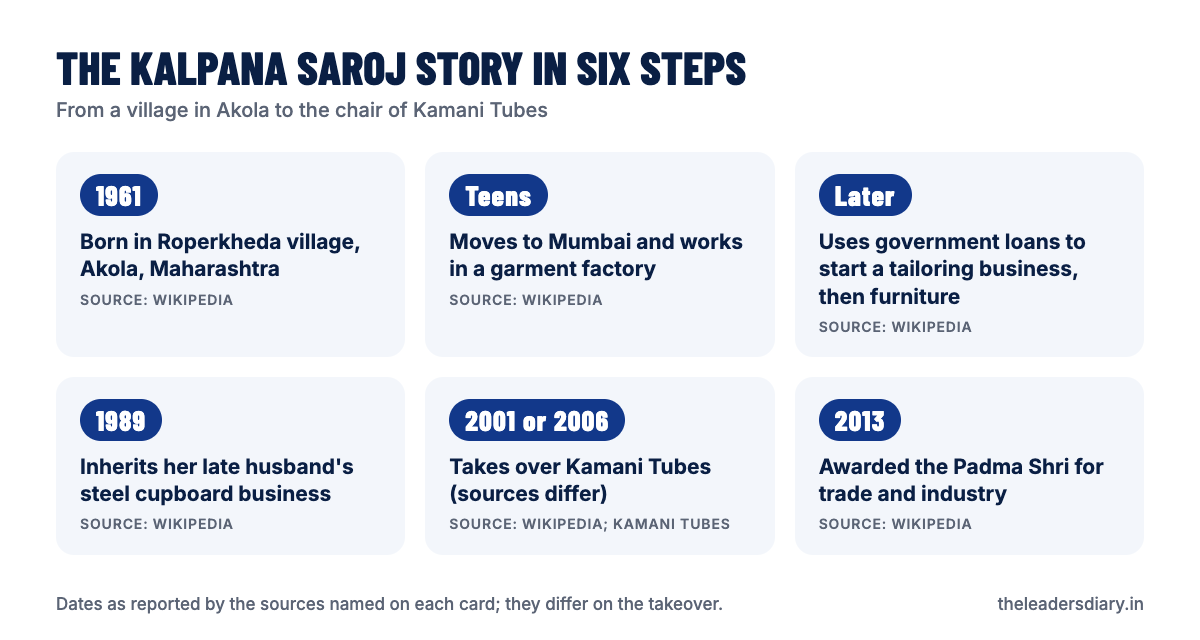
- Born in 1961 in Akola, Kalpana Saroj began with a garment-factory job, then used government loans to start a tailoring business, per Wikipedia
- Kamani Tubes' own site says production had stopped for over 17 years before she took over management; it says dues were paid and over 140 legal cases settled
- The takeover year differs by source: 2001 (Wikipedia) or 2006 (company website); she received the Padma Shri in 2013
Kalpana Saroj was born in 1961 in a village in Akola, Maharashtra, into poverty. Wikipedia says she was married at 12 and later reached Mumbai, where she worked in a garment factory earning, reportedly, less than a dollar a month. Years later she took charge of Kamani Tubes, a copper company that had stopped production, and the company says she brought it back to profit. In 2013 she received the Padma Shri for trade and industry.
Her story is often told as a story of grit. Below is what two sources say, where they disagree, and what an entrepreneur can learn from the way she rebuilt a company that many had written off.
A hard start
According to Wikipedia, Saroj was born in Roperkheda village in Akola district, the eldest of five children, and her father was a police constable. She was married at 12 and lived in a Mumbai slum with her husband's family. After facing abuse there, she was taken back to her village by her father. At 16 she returned to Mumbai to live with an uncle and found work in a garment factory.
These details come from published interviews summarised by Wikipedia, and they are painful. We mention them because they show what she started from, not to dwell on them.
From tailoring to business
Wikipedia says that using government loans for people from scheduled castes, she started a tailoring business and then a furniture store, later building a real estate business. In 1989, it says, her husband died and she inherited his steel cupboard manufacturing business. She is described as being born into the Dalit community, and the same page says she follows the teachings of Dr B. R. Ambedkar.
Taking over Kamani Tubes
Kamani Tubes' own website says the company was founded in 1959 by Ramjibhai Kamani as a pioneer in India's non-ferrous metals industry. Because of shifting economic conditions and labour unrest in the late twentieth century, it says, the company faced serious difficulties and production stopped for over 17 years. It was referred to the Board for Industrial and Financial Reconstruction as a sick unit.
The company's site says that in 2006 its management was taken over by Padma Shri Kalpana Saroj, and describes what followed:
- Debts: historic debts and liabilities were cleared.
- Workers: over 140 litigation cases were settled and workers' dues paid, which it says restored trust.
- Modernisation: the old facilities in Kurla were replaced by a new manufacturing complex at Wada, Palghar.
The company describes itself today as a debt-free, ISO 9001:2015 certified maker of brass rods and bare copper wire, headquartered in Ballard Estate, Mumbai. Wikipedia gives a different timeline, saying she was on the board when the company went into liquidation in 2001 and then took it over, restructured it and brought it back to profit. We could not reconcile these two dates (2001 and 2006), so we show both.
Recognition
- She was awarded the Padma Shri in 2013 for trade and industry, according to Wikipedia.
- Wikipedia also says she was appointed to the board of the Bhartiya Mahila Bank and serves on the board of governors of IIM Bangalore.
- Wikipedia reports that, by her own estimates, she has personal assets worth $112 million. That is her own estimate, not a verified figure.
What we could not confirm
- The exact year she took over Kamani Tubes: 2001 (Wikipedia) or 2006 (company website).
- Her early-life details, which come from press interviews and which we have not checked against records. We have left out the most distressing episodes.
- Kamani Tubes' current sales and profits, which the company's website does not state.
- The Padma Shri listing in the Ministry of Home Affairs record, which we could not open.
Five lessons from the Kalpana Saroj story (our analysis)
- Use the help that exists. She used government loans meant for her community to begin a small business.
- Start with something you can do. Tailoring, then furniture, then property: each step used what she had learned.
- Look for value others have written off. A "sick unit" referred to a board for reconstruction looked like a problem to most people.
- Fix trust first. The company says it settled workers' dues and many legal cases before it could move forward.
- Rebuild, do not just reopen. A new, modern plant replaced the old one.
If you want to start with little
- Find out which government loan schemes you might be eligible for, and read the terms carefully before you sign.
- Start with a service or product you can deliver now, and use our break-even calculator to work out what you need to earn.
- If you take over or buy a business, ask a CA and a lawyer to check its debts and legal cases first.
Questions people ask
Who is Kalpana Saroj?
An Indian entrepreneur and the chairperson of Kamani Tubes, Mumbai, who was awarded the Padma Shri in 2013 for trade and industry.
What is Kamani Tubes?
A Mumbai-based maker of copper and copper alloy products, founded in 1959, now producing brass rods and bare copper wire according to its website.
When did she take over Kamani Tubes?
The company says 2006. Wikipedia says she took it over after 2001. The sources differ.
How did she start her business career?
According to Wikipedia, with a tailoring business started using government loans, followed by a furniture store and real estate.
Know a story like this?
If you rebuilt something that others had given up on, tell us your story.
This article is compiled from Kamani Tubes' public website and Wikipedia and is not affiliated with or endorsed by Kalpana Saroj or Kamani Tubes. Figures are reported claims and may have changed. The lessons are our own analysis.
Sources
- Kamani Tubes Limited, official website (company history)
- Wikipedia, Kalpana Saroj (secondary source, cites BBC, Indian Express and others)
- Cover photo: Alfred T. Palmer, "Copper and Brass - Inside brass and copper tube mill" (Wikimedia Commons, public domain)
- The five lessons are our own analysis. This article is not affiliated with Kalpana Saroj or Kamani Tubes.
Figures are estimates and vary by city, size and season. Last reviewed: 15 Oct 2026.