By the numbers
- Founded
- 2 July 1981, Pune
- Founders
- Seven
- Initial capital
- $250 (per Wikipedia)
- Moved to Bangalore
- 1983
- IPO price
- ₹95 a share (February 1993)
- Nasdaq listing
- March 1999
- Employees
- About 328,594 (March 2026, per Wikipedia citing the Economic Times)
- Please note
- Facts are from Wikipedia and the sources it cites. Infosys's own site blocks automated readers, so we could not check company pages.
Key takeaways
- Seven co-founders registered Infosys in Pune on 2 July 1981, with $250 of capital per Wikipedia, and moved to Bangalore in 1983
- It made hardware at first, grew in software after 1991, and listed on Nasdaq in 1999 as the first Indian company there
- The $250 figure comes from Wikipedia and is not confirmed on Infosys's own pages, which block automated readers
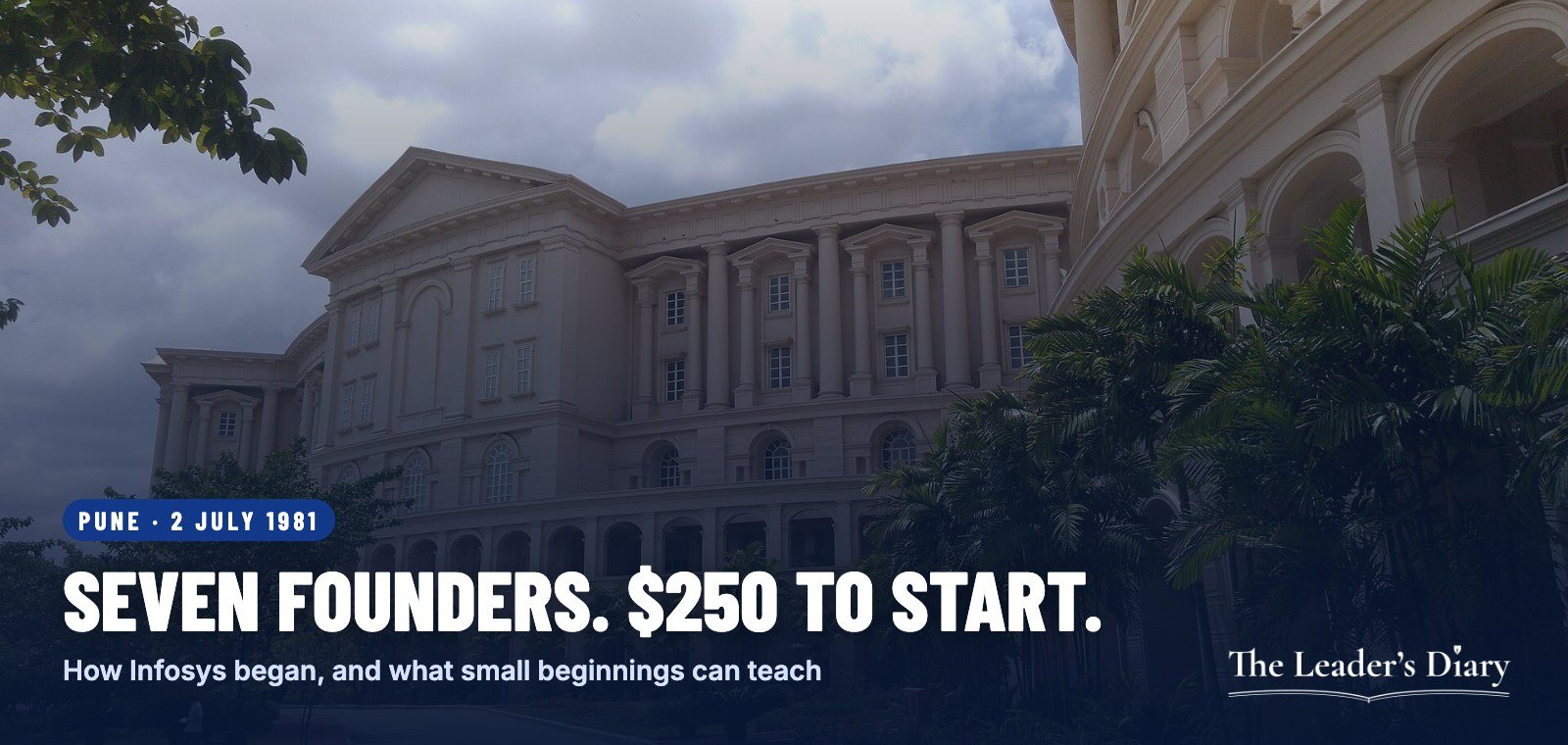
On 2 July 1981, seven co-founders registered a small company in Pune. According to Wikipedia, Infosys began with an initial capital of $250. More than forty years later, the company reports about 328,000 employees (March 2026) and was the first Indian company to list on Nasdaq.
The Infosys story is often told as a lesson in patience and values. Below is what published sources say about how it started, what happened in its early years, and what the story can teach anyone who is starting with very little.
Seven founders, one idea
Wikipedia lists the seven founders as N. R. Narayana Murthy, Nandan Nilekani, Kris Gopalakrishnan, S. D. Shibulal, K. Dinesh, N. S. Raghavan and Ashok Arora. The company was incorporated as Infosys Consultants Private Limited in Pune on 2 July 1981 and moved to Bangalore in 1983. Ashok Arora left in 1989 and sold his shares to the other co-founders.
The initial capital figure of $250 comes from Wikipedia. We could not confirm it from the company's own pages, which block automated readers, so treat it as a widely reported figure rather than a company statement.
The early years
In the 1980s, Wikipedia says, Infosys briefly made hardware products, such as electronic telex machines and keyboard concentrators. Its main business, offshore custom software development, grew after India's economic liberalisation in 1991.
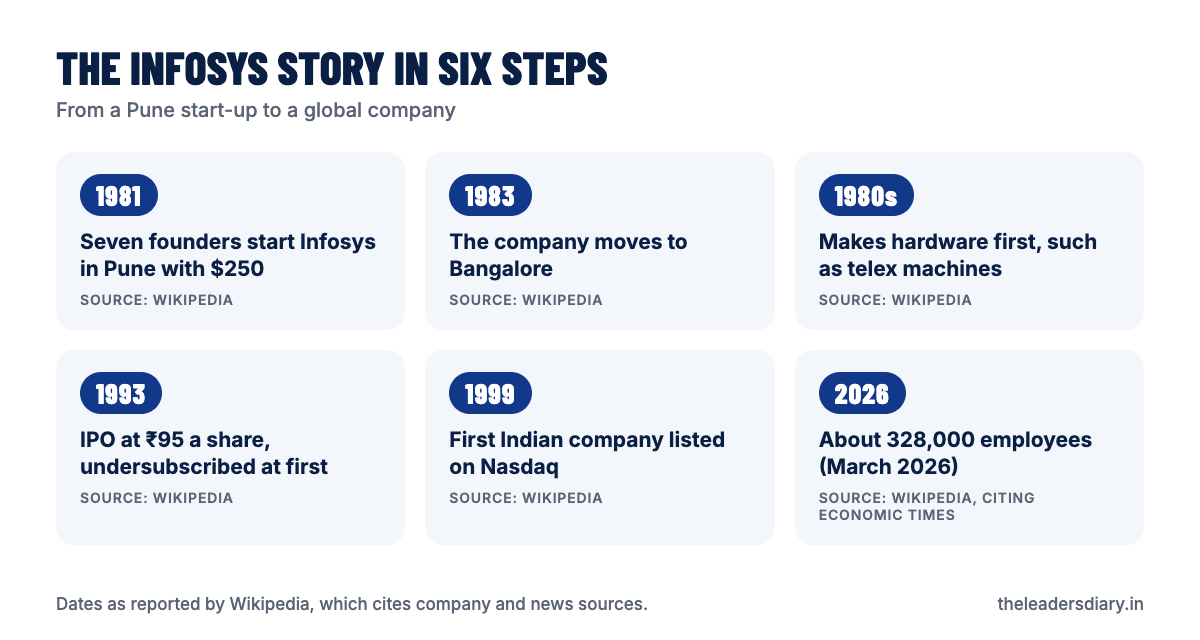
- 1993: Infosys launched its IPO at ₹95 a share. It was initially undersubscribed, which led Morgan Stanley to buy a 13% stake to stabilise the price. The shares opened at ₹145 in June 1993.
- 1999: It listed American depositary receipts on Nasdaq in March 1999, the first Indian company to do so.
- 1999: It released Finacle, a core banking software suite.
- 24 August 2021: Infosys became the fourth Indian company to reach a market capitalisation of US$100 billion.
- March 2026: The company had 328,594 employees, according to Wikipedia, citing the Economic Times.
What we could not confirm
- The $250 starting capital, from the company's own records.
- Detailed stories about the early days, such as who put in how much. Many are told in books and interviews, but we have not checked them against a primary source.
- Current financial figures. Infosys's annual reports are the right place for those.
Five lessons from the Infosys story (our analysis)
- You can start tiny. A very small amount of capital and a clear skill were the starting point.
- Be ready to change what you sell. The company made hardware before it settled on software services.
- Team matters. It began with seven co-founders, each bringing a different strength.
- Stay with it through setbacks. Its IPO was undersubscribed at first, yet the shares later rose.
- Grow through trust. Listing on public markets came with the duty to publish accounts and follow rules.
If you are starting small
- Begin with what you can already do well.
- Write a simple agreement with your partners about roles, money and what happens if someone leaves.
- Test your idea with a few customers, and use our break-even calculator to see the sales you need.
- If you think about franchising or partnering, read our guide to franchise business in India.
Questions people ask
Who founded Infosys?
Seven people: N. R. Narayana Murthy, Nandan Nilekani, Kris Gopalakrishnan, S. D. Shibulal, K. Dinesh, N. S. Raghavan and Ashok Arora.
When and where was Infosys founded?
On 2 July 1981 in Pune. It moved to Bangalore in 1983.
How much money did Infosys start with?
Wikipedia reports $250 of initial capital. We could not confirm this from the company.
Was Infosys the first Indian company on Nasdaq?
Wikipedia says its American depositary receipts listed on Nasdaq in March 1999, making it the first Indian company listed there.
Know a story like this?
If you started a company with very little, tell us your story.
This article is compiled from Wikipedia and the public sources it cites and is not affiliated with or endorsed by Infosys. Figures change over time. The lessons are our own analysis and this is not investment advice.
Sources
- Wikipedia, Infosys (secondary source, cites company and news sources)
- Cover photo: L'Astorina, "Infosys Mysore Campus" (Wikimedia Commons, CC BY 4.0)
- Photo licence: Creative Commons Attribution 4.0 (CC BY 4.0)
- The five lessons are our own analysis. This article is not affiliated with Infosys.
Figures are estimates and vary by city, size and season. Last reviewed: 15 Oct 2026.